LEAF MAX 8000 — Foliage & Photosynthesis
LEAF MAX 8000 — Foliage & Photosynthesis
Couldn't load pickup availability
LEAF MAX 8000 — Foliage & Photosynthesis
Registered name: NPK NNTBD PACIFICNPK 32-9-9 · Form: powder, 500 g jar Application method: Root application · VN Product code: 15203 · VN Registration: 1999/QĐ-BVTV-PB · Shelf life: 24 months
Short description
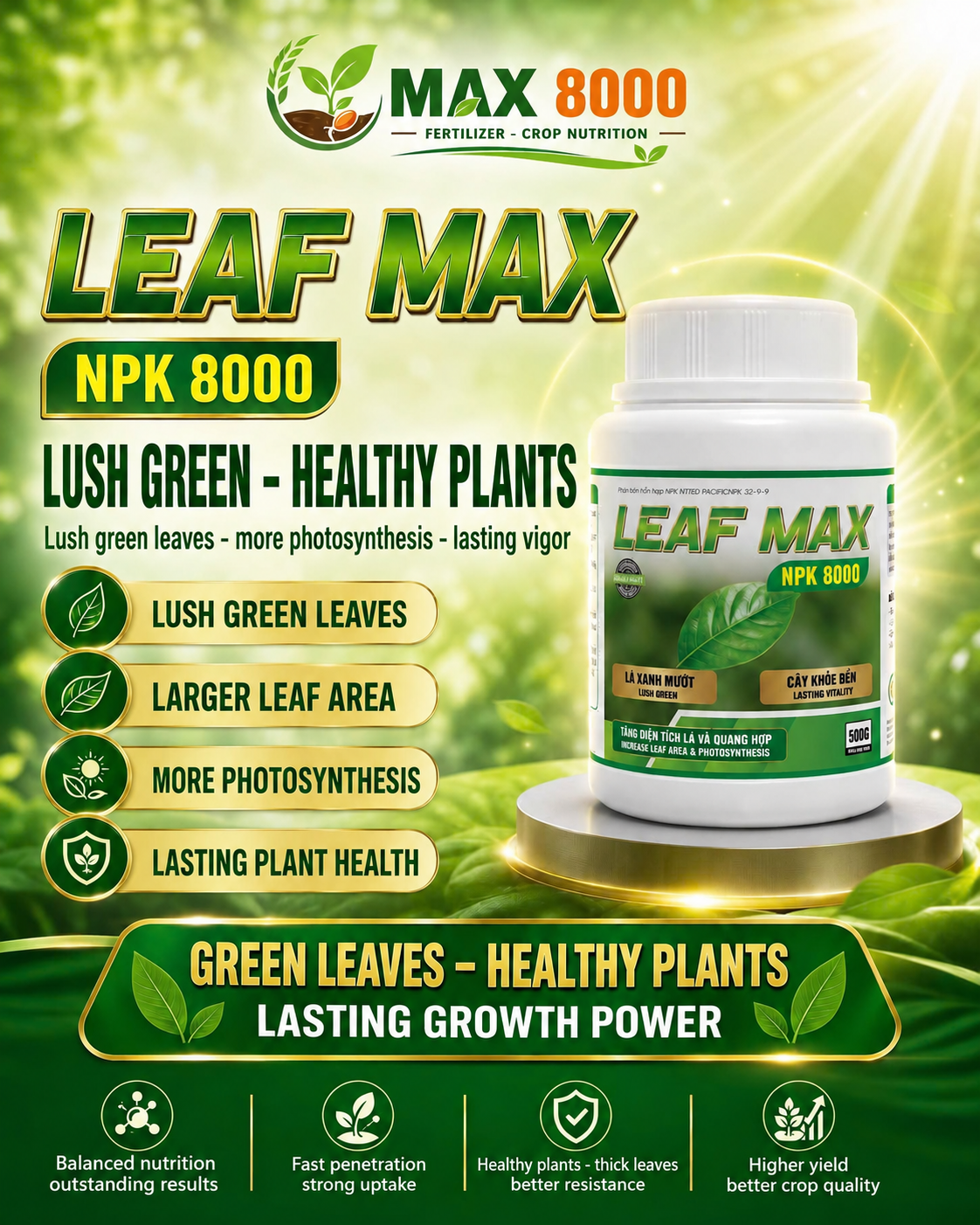
LEAF MAX 8000 is a high-nitrogen 32-9-9 feed supplemented with Mg, Fe and Zn — for lush, thick, deep-green foliage, larger leaf area and stronger photosynthesis. 500 g jar.
Full description
What it does:
- Photosynthetic optimization: expands leaf surface area and triggers rapid chlorophyll synthesis for lush, thick, and vibrant foliage.
- Nutrient deficiency defense: provides essential Mg, Fe, and Zn to eliminate yellowing and interveinal chlorosis.
- Thermal & stress recovery: cools the plant and ensures rapid recovery from extreme heat and drought; rapidly restores pigments and vitality after fertilizer- or pesticide-induced shock.
When to use: during flushing and leaf-building stages; when foliage is pale, thin or weak; after a spell of harsh heat.
Guaranteed analysis (as declared on the label)
| Nutrient | Content |
|---|---|
| Total Nitrogen (N) | 32% |
| Available Phosphate (P₂O₅) | 9% |
| Soluble Potash (K₂O) | 9% |
| Moisture | 5% |
Supplemented with other secondary and micro-elements.
Directions for use (as printed on the label)
1. Fruit vegetables, flowering plants, food crops: basal dressing or top-dressing for tillering. One 500 g jar covers approx. 40–50 m² (430–540 sq ft) per application — equivalent to 100–120 kg/ha (89–107 lb/acre).
2. Long-term industrial crops and fruit trees:
- Young plant stage: apply 100–200 g (3.5–7 oz) per plant per application (one jar for approx. 3–5 plants).
- Recovery stage: apply 400–500 g (14–17.6 oz) per plant per application (one jar for 1 plant).
3. Root crops: basal dressing and top-dressing for young plants. One 500 g jar covers approx. 15–17 m² (160–185 sq ft) per application — equivalent to 300–350 kg/ha (268–312 lb/acre).
Share